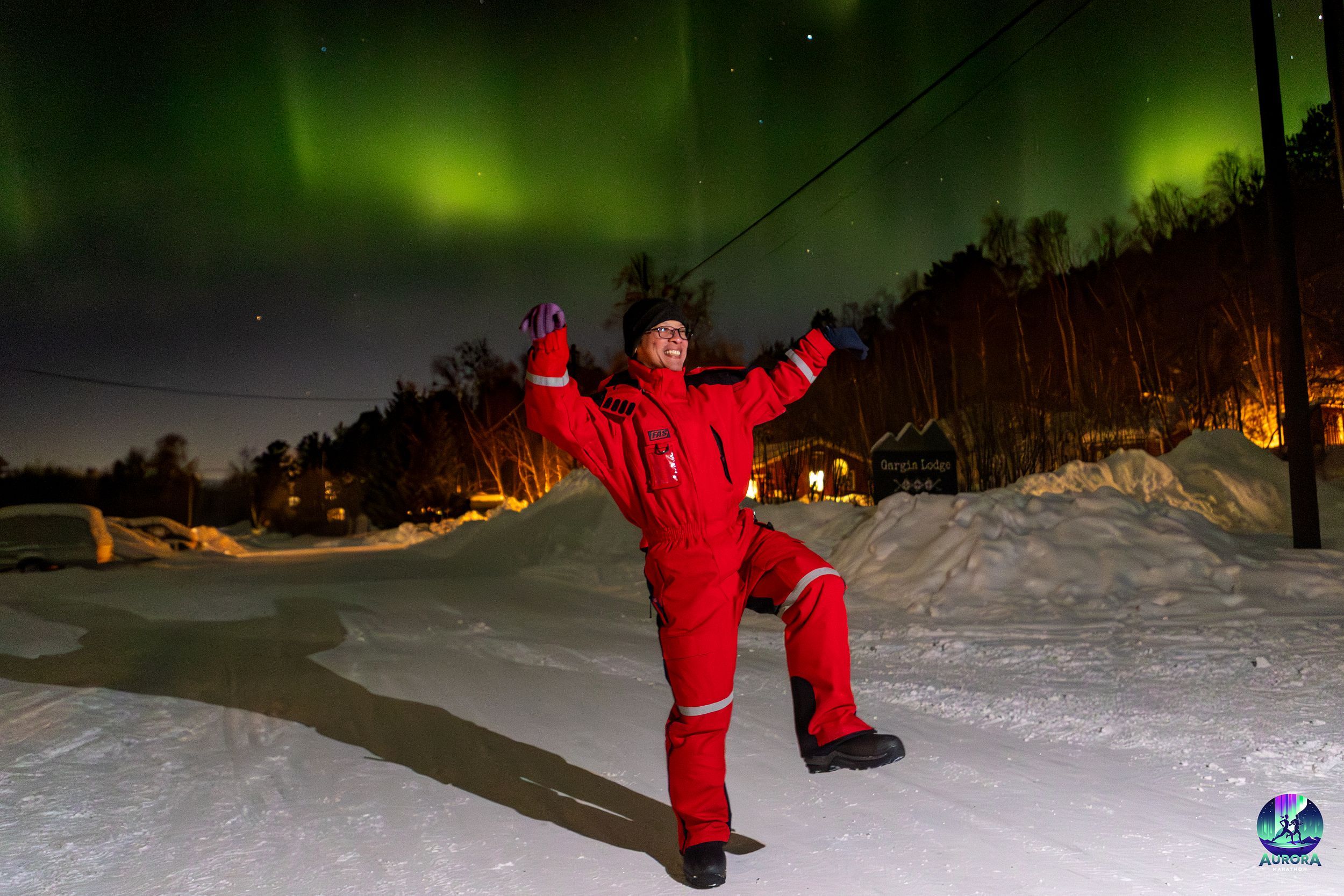
Northern Lights in Alta, Norway: The Complete Guide
Alta, in Arctic Norway, is one of the best places on Earth to see the northern lights. The town sits at 70°N, directly beneath the auroral oval, and has a drier, more stable winter climate than the outer coast. From late August to mid-April the nights are dark enough, and on a clear evening even modest solar activity is often all it takes.
We are Æventyr, a local company based at Gargia Lodge just south of town. This guide to the northern lights in Alta covers what we would tell a friend planning a trip: why Alta, when and where to look, tour or DIY, and how to dress, get here and where to stay.
Why Alta is called the City of the Northern Lights
Locals call Alta Nordlysbyen, "the City of the Northern Lights." The name comes from geography, climate and darkness, plus almost two centuries of aurora science. For the short version, see our page on why Alta.
Right under the auroral oval
The northern lights are most frequent in a ring around the geomagnetic pole called the auroral oval, and Alta lies right underneath it. That is why you can often see aurora directly overhead here even when the Kp index is only 1–3. The Kp index is a global 0–9 scale of how disturbed Earth's magnetic field is. Further south you need high Kp numbers to see anything; in Alta, an ordinary night is often enough.
Our guide to the northern lights map explains the oval in more detail. If you are new to the aurora, start with what the northern lights are and what causes the northern lights.
A drier, inland climate
Alta lies at the head of Altafjord, sheltered by mountains, with the vast Finnmark plateau (Finnmarksvidda) behind it. The result is drier, more settled winter weather than on the exposed Atlantic coast. Alta's normal annual precipitation is around 440 mm (17 inches), compared with more than 1,000 mm (about 40 inches) in Tromsø.
Precipitation is not the same as cloud cover, but a drier climate generally means more clear spells, and clear skies are what you need. We compare the two in more depth in our guide to the northern lights in Tromsø.
Long, dark nights
It is dark enough for aurora from late August to mid-April. During the polar night (mørketid), from around November 24 to January 17, the sun does not rise above the horizon at all. That gives you many hours to watch each evening, while the middle of the day still glows with soft blue twilight.
A long history of aurora science
In 1838–39 the French La Recherche expedition wintered at Bossekop in Alta to study the aurora. According to Alta Museum, they chose Altafjord over Hammerfest because there was less cloud and fog. The oldest surviving aurora photograph was taken at Bossekop in 1892, and in 1899 Kristian Birkeland built the Haldde observatory above Alta, regarded as the world's first permanent northern lights observatory. Read the full story in Kristian Birkeland and the northern lights.
When to see the northern lights in Alta
The short answer: any clear, dark night between late August and mid-April. From late April to mid-August the nights are too bright, and from about May 16 to July 27 Alta has the midnight sun.
- September–October: Dark evenings, often milder weather, and the weeks around the fall equinox tend to bring higher geomagnetic activity.
- November–January: Polar night and long hours of darkness. Cold, but plenty of time to watch.
- February–March: More daylight, often stable winter weather, and the March equinox is a strong period.
- First half of April: Shorter nights, but still chances late in the evening.
Once it is properly dark, the best window is typically 6 p.m. to 2 a.m., with activity often peaking around 10 p.m. to midnight. That said, the aurora can appear any time it is dark.
For a month-by-month breakdown, see the best time to see the northern lights in Norway. Planning for this evening? Use our checklist for the northern lights tonight, and learn to read the numbers in our northern lights forecast guide for Alta.
Where to see the northern lights around Alta
The sky is the same over the whole area, but the experience is not. What matters most is darkness, an open view to the north and, of course, a clear patch of sky.
Gargia Lodge and the Finnmark plateau
Gargia Lodge sits 25–30 minutes' drive south of Alta, on the edge of Finnmarksvidda. People have run a mountain lodge here for more than 300 years, and it is properly dark: no streetlights, no glow from town on the horizon, just snow, hills and sky. It is our base, and one of our two live webcams points at the sky here.
Kristian Birkeland stopped at Gargia in February 1897 while searching for a site for his observatory. Read more about why to stay at Gargia Lodge.
Get away from the town lights
You can see strong aurora from downtown Alta, but streetlights wash out the fainter shapes and colors. A 20–40 minute drive out of town makes a big difference, both to the darkness and often to the clouds, which can vary a lot over short distances.
If you drive yourself, pick a spot with an open view north, park only where it is legal and safe (never on the road shoulder), and watch for reindeer on dark winter roads. If you are not used to icy roads in the dark, a guided tour is the more relaxed option.
The Northern Lights Cathedral
The Northern Lights Cathedral (Nordlyskatedralen), Alta's church, opened in 2013 and has become the symbol of the town. Its titanium-clad spire spirals upward like a ribbon of aurora, and the basement houses an exhibition on Alta's long northern lights history.
It stands in the middle of town, so it is not the darkest place to watch. But a strong display over the cathedral is one of the most iconic photos you can take in Alta.
Check the sky live before you go
On our northern lights forecast page you can watch the sky over Gargia Lodge and Altafjord around the clock, alongside Kp, cloud cover and the darkness window. Already outside and wondering if that faint glow is aurora? Open our quick guide to the northern lights live.
Guided northern lights tour or DIY?
Both can work in Alta. The real question is how much time, winter-driving experience and local knowledge you bring.
- Transport
- On your own: You need a car and must drive winter roads in the dark
- Guided tour with Æventyr: We drive, you watch the sky
- Weather and clouds
- On your own: You read forecasts and satellite images yourself
- Guided tour with Æventyr: Local guides read weather and aurora data and move to clearer spots when needed
- Locations
- On your own: You find safe, dark places yourself
- Guided tour with Æventyr: We know the terrain around Alta and on the plateau
- Photography
- On your own: Trial and error
- Guided tour with Æventyr: Help with camera settings
- Clothing
- On your own: Whatever you packed
- Guided tour with Æventyr: Extra warm clothing provided on tours
- Cost
- On your own: Cheapest, total freedom
- Guided tour with Æventyr: Costs more, but you get more out of the night
Going on your own
In the afternoon, check three things: that it will be dark enough, that cloud cover is low where you plan to go (use yr.no, the Norwegian weather service), and that there is some aurora activity. Have a backup direction in case clouds roll in, dress to stand still for a long time, and be patient, because the aurora often comes in waves.
What you get on a tour with us
Our guides live here and follow weather and aurora data all evening. If it is cloudy where we are, we move to where the sky is clearer. We help you with camera settings, bring extra warm clothing and keep tours small and personal.
Nobody can guarantee the northern lights, including us. But being in the right place at the right time is what gives you the best odds. See our northern lights tours, or read more on our northern lights in Alta page.
What to wear for the northern lights in Alta
Aurora watching means a lot of standing still outdoors, and inland on the plateau it is often colder than by the fjord. Dress in layers, the way Norwegians do:
- Base layer: merino wool top and long johns.
- Mid layer: a wool sweater or fleece that traps heat.
- Outer layer: windproof jacket and pants, ideally with a thick down jacket on top.
- Feet: insulated winter boots with room to wiggle your toes, plus thick wool socks.
- Hands and head: mittens (with thin gloves underneath for your camera), a warm hat and a neck gaiter.
Bring spare batteries for your phone and camera, since the cold drains them fast. Our full guide on how to dress for the Arctic has more detail, and if you are missing something, you can rent Arctic outdoor gear in Alta instead of buying it.
How to get to Alta
Most international travelers fly to Oslo and connect to Alta Airport (ALF), about a two-hour direct flight. There are also direct flights from Tromsø, around 45 minutes, which makes it easy to combine the two. Driving from Tromsø takes roughly six hours.
The airport is a short drive from the town center, and Gargia Lodge is another 25–30 minutes south; get in touch and we can help arrange your transfer. Flights, car and bus options are all covered on our travel to Alta page.
Where to stay, and what else to do
Staying in town puts cafés and shops on your doorstep, but you will usually need to head out of town for the best views. At Gargia Lodge it is the other way around: the darkness starts at the front steps. You can step out into the snow after dinner, check the sky and come back in to warm up whenever you like. Browse our accommodations and packages that combine stays, activities and meals.
There is also plenty to fill the days: many guests combine the aurora with dog sledding, snowmobiling or authentic Sámi experiences, and the rock art at Alta Museum is a UNESCO World Heritage Site.
Join us under the northern lights
Alta gives you some of the best conditions in the world for the aurora. The rest is about being in the right place when the sky opens up, and that is exactly what we do. Our guides know the plateau, read the weather and take you where your chances are best, with warm clothing and photo help along the way.
See our northern lights tours and pick your night, and we will take you out into the dark.
Your trusted guide to Arctic adventures. We specialize in creating unforgettable experiences in Alta, Norway.