What Causes the Northern Lights? From Solar Storm to Night Sky, Step by Step
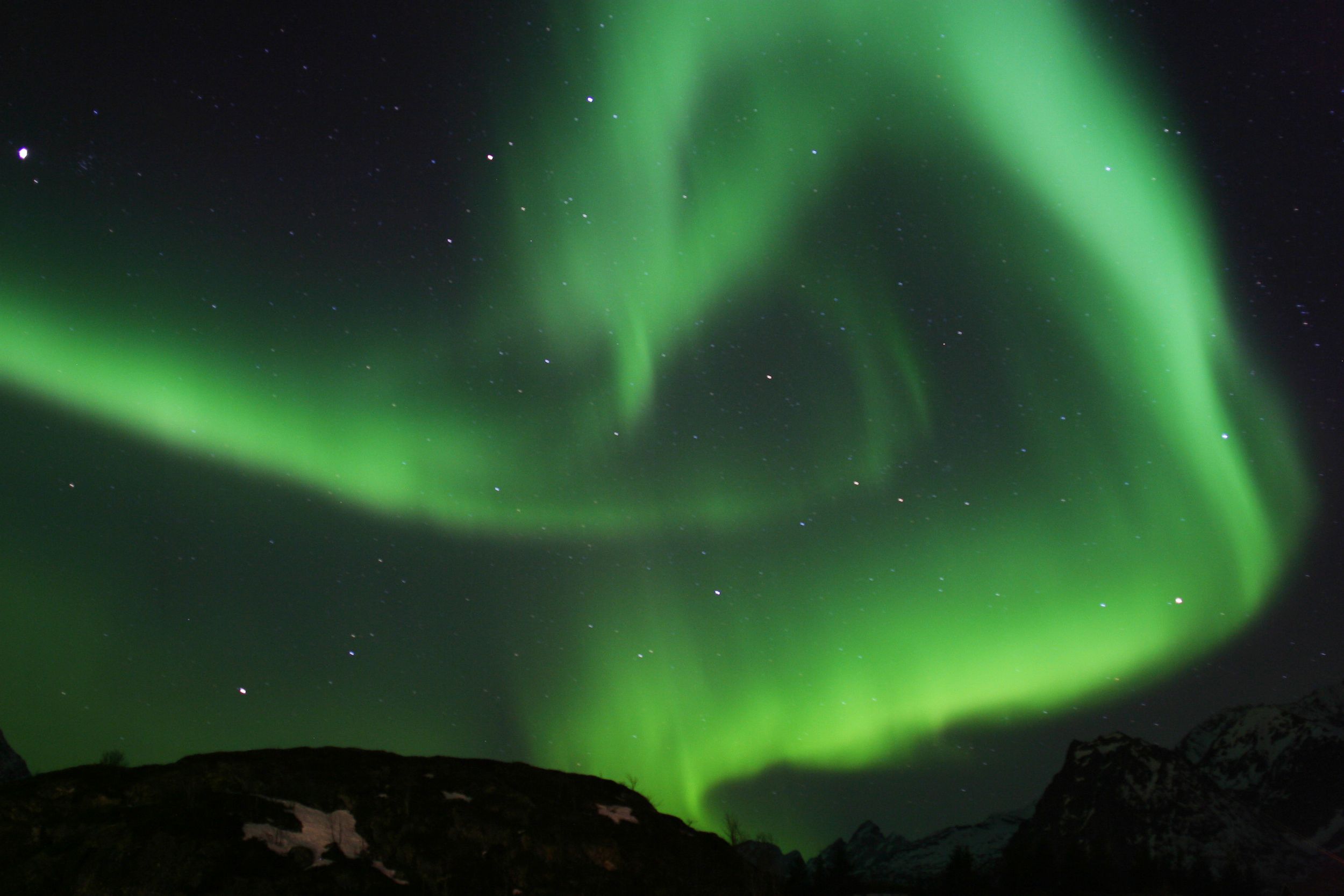
What causes the northern lights? It starts with the solar wind, a stream of electrically charged particles from the Sun, hitting Earth's magnetic field. Energy builds up on the night side of the planet and is released in bursts, sending electrons racing down toward the atmosphere around the poles. About 100–300 km (60–190 miles) up, they slam into oxygen and nitrogen, which glow green, pink and red.
Below is the full journey from the Sun to the sky over Alta, Northern Norway, where we live under the aurora. For names, colors and folklore, start with what the northern lights are.
What causes the northern lights? The journey in seven steps
- The Sun sends out the solar wind.
- The solar wind crosses space.
- Earth's magnetic field takes the hit.
- A "door" opens when the magnetic fields link up.
- Energy is stored in the magnetotail, then released.
- Electrons dive down along the magnetic field.
- Collisions in the atmosphere create light and color.
Step 1: The Sun sends out the solar wind
The Sun's outer atmosphere, the corona, is over a million degrees, so hot that some of its gas constantly escapes into space. That stream is the solar wind: electrons and protons usually moving at 300–500 km per second (roughly 0.7–1.1 million mph), carrying part of the Sun's magnetic field along. It always blows, but two sources give it extra push.
Coronal holes: fast streams that come back
Coronal holes are areas where the Sun's magnetic field opens into space, letting the solar wind escape faster. Seen from Earth, the Sun rotates about once every 27 days, so like a sweeping garden sprinkler, the same fast stream can hit us again on the next turn.
Sunspots, solar flares and coronal mass ejections
Sunspots are darker areas where the magnetic field is strong and twisted. When that field suddenly snaps into a new shape, it can produce a solar flare (an intense flash of light) and often a coronal mass ejection, or CME: a huge cloud of gas and magnetic field hurled into space. When a CME hits Earth, most people call it a solar storm.
Step 2: The solar wind crosses space
Earth is about 150 million km (93 million miles) from the Sun. Light from a flare arrives in about eight minutes, but particles take far longer: a few days for ordinary solar wind, usually 1–3 days for a CME. Arrival forecasts can be off by many hours.
The most reliable warning comes from satellites about 1.5 million km away, between Earth and the Sun. They measure the solar wind roughly 30–60 minutes before it reaches us. NOAA publishes the data in real time, and our northern lights forecast guide explains how to read it.
Step 3: Earth's magnetic field takes the hit
Earth is a giant magnet, and the region its field controls is the magnetosphere. It works like a shield: most of the solar wind flows around it, the way a river flows around a boulder.
On the Sun-facing side, the magnetosphere is squeezed to around 65,000 km from Earth. On the night side it is stretched into a long tail, the magnetotail, reaching far beyond the Moon's orbit.
Step 4: A "door" opens when the magnetic fields link up
The shield is not sealed. The solar wind brings its own magnetic field, and Bz is the north–south direction of that field. Earth's field points north on the Sun-facing side, so when the solar wind's field points south (negative Bz), the two connect. Scientists call this magnetic reconnection.
Think of two magnets snapping together when you turn them the right way. A door opens: energy and particles pour in, and the connected field lines are dragged over the poles to the night side. When Bz points north, the door stays mostly shut, even if the solar wind is fast. That is why aurora chasers watch Bz so closely.
Step 5: Energy is stored in the magnetotail, then released
Field lines pile up in the magnetotail, stretching it like a rubber band until it snaps back. This is a substorm, firing particles toward Earth at high speed.
Over Alta it often looks like this: a calm arc sits in the sky, brightens and drifts, then suddenly breaks up into dancing curtains across the whole sky, before settling into soft, pulsating patches. This can happen several times a night, often around 10 p.m. to midnight, when Alta faces straight down the magnetotail, a time known as magnetic midnight.
Step 6: Electrons dive down along the magnetic field
Charged particles cannot move freely across a magnetic field. They spiral along the field lines like beads on a string. The field lines from the magnetotail reach the atmosphere in a ring around each magnetic pole: the auroral oval. So the aurora forms a belt around the pole, not over it.
Alta lies under the northern oval, so the aurora can appear here even when the Kp index, a global 0–9 scale of how disturbed Earth's magnetic field is, sits at just 1–3. Major storms push the oval south; our northern lights map guide shows how to follow it.
Step 7: Collisions create light and color
When electrons hit oxygen and nitrogen, the gases absorb energy and release it as light in very specific colors, just like a neon sign. The wavelength, in nanometers (nm), sets the color.
- Green (oxygen, 557.7 nm, about 100–250 km up): Oxygen releases this light in under a second, even where the air is fairly dense, which makes green the most common color.
- Red (oxygen, 630 nm, above about 250 km): This light takes almost two minutes to come out. Lower down, collisions steal the energy first, like trying to finish a long sentence in a crowded room where someone always interrupts. Only in extremely thin air is the atom left alone long enough. Red mostly appears during strong storms.
- Pink, purple and blue (nitrogen, lower edge about 90–100 km): Extra-energetic electrons penetrate deeper and hit nitrogen, giving the curtains a pink fringe, typically when the aurora dances hardest.
Why do the northern lights look like curtains?
The electrons follow field lines that up here are nearly vertical, so the aurora forms tall, thin curtains with rays along the field. Directly overhead, the rays seem to meet at a single point, the way railroad tracks meet on the horizon.
From Bossekop to satellites: Alta as an aurora laboratory
In 1838–39 the French La Recherche expedition wintered at Bossekop in Alta and estimated the aurora at 90–150 km up.
From 1899, physicist Kristian Birkeland observed from Mount Haldde above Kåfjord, regarded as the world's first permanent northern lights observatory. In his lab he recreated the auroral oval in miniature by firing electrons at a magnetized sphere, the terrella. His idea of electric currents flowing along the magnetic field was disputed for decades, until satellites confirmed these Birkeland currents in the 1960s and '70s. Read more about Kristian Birkeland and the northern lights.
What this means for seeing the northern lights
- Kp gives a rough picture of activity. In Alta, low Kp is often enough.
- Bz and solar wind: Sustained negative Bz plus solar wind above 500 km/s means the door is open.
- The 27-day rule: A coronal hole that brought good aurora may return four weeks later.
- Patience: Substorms come in waves. A quiet spell can be followed by the next burst.
- Clouds have the final say. Check the cloud forecast on yr.no.
See the physics in action over Alta
So what causes the northern lights, in one sentence? Energy from the Sun, steered by Earth's magnetic field, makes the air 100–300 km above us glow. Our live northern lights forecast shows Kp, cloud cover and two webcams, at Gargia Lodge and over the Alta Fjord, showing what is happening right now.
To experience it with people who know this sky, join our northern lights tours from Alta. Our guides read weather and aurora data, drive to clear skies and help with your camera. No one can guarantee the aurora, but we give you the best possible chance.
Your trusted guide to Arctic adventures. We specialize in creating unforgettable experiences in Alta, Norway.