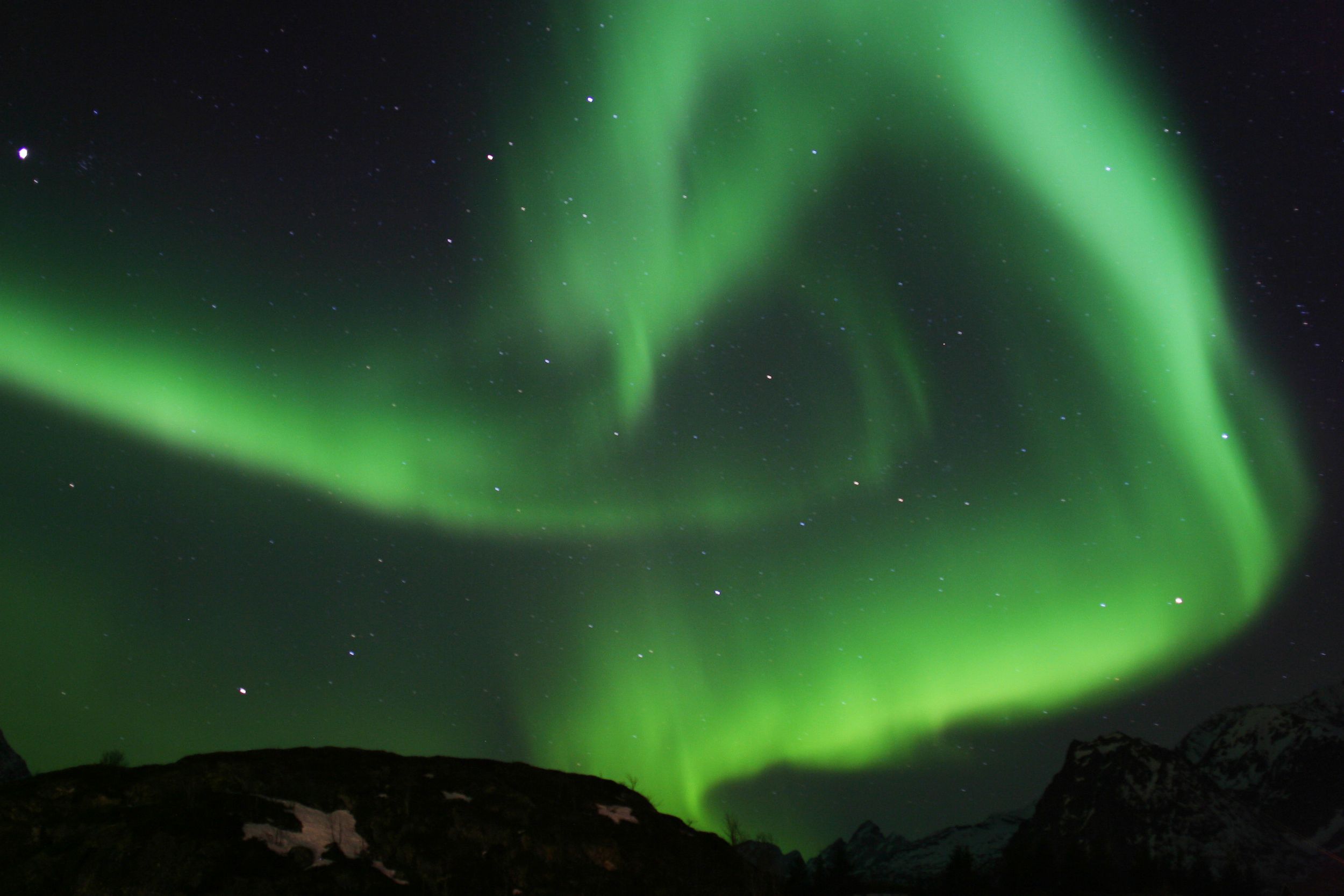
Northern Lights Forecast for Alta, Norway: How to Read It and Watch the Sky Live
A northern lights forecast estimates your chance of seeing the aurora, and it rests on three things: space weather activity (the Kp index and the solar wind), cloud cover, and darkness. In Alta, which sits right under the auroral oval, even low activity is often enough. Clear skies are usually what decides your night.
Once you've read the forecast, our webcams show you the answer: is the aurora out or not? This guide explains what goes into a northern lights forecast, how to read every part of our live northern lights forecast for Alta, how far ahead you can trust the numbers, and which sources we use ourselves when we plan the evening's tour.
What a northern lights forecast is made of
For you to actually see the aurora, three conditions have to line up at the same time. A good forecast checks all three.
Activity: the Kp index and the solar wind
The Kp index is a global scale from 0 to 9 that measures how disturbed Earth's magnetic field is, calculated in three-hour blocks. It's useful for a general sense of activity, but it says little about exactly when the lights will switch on above you.
Solar wind data is more precise. The key number is Bz, the north–south direction of the magnetic field the solar wind carries with it. When Bz points south (negative values) for a while, more energy gets into Earth's magnetic environment, and the odds of aurora go up. A fast solar wind helps too.
Cloud cover
The aurora glows 100–300 km (roughly 60–190 miles) above the ground, far above any clouds. A solid cloud layer blocks everything, no matter how strong the activity is. In Alta, it's almost always the clouds, not the Kp, that decide whether you see the northern lights.
This is where Alta has an edge. The town sits at the head of Altafjord, sheltered by mountains with Finnmarksvidda, the wide Finnmark plateau, behind it. Winter weather here is drier and more stable than on the outer coast. Back in 1838, the French La Recherche expedition chose Altafjord over Hammerfest for exactly that reason: less cloud and fog.
Darkness
Aurora activity can happen during the day, but you can only see it when the sky is dark. In Alta, it's dark enough from late August to mid-April. From roughly late April to mid-August, bright nights and the midnight sun make it impossible.
How to read our live northern lights forecast for Alta
Our forecast page brings activity, clouds, darkness and two live webcams together in one place. Here's how to read each part.
"Can you see the aurora tonight?"
At the top you'll find a short plain-language outlook and a chance in percent. The percentage combines activity (Kp) with forecast cloud cover in Alta over the next 12 hours. A score of 70% or more is shown as a good chance, 40–69% as moderate and below 40% as low. Treat it as a rule of thumb, not a promise.
If it's still light in Alta, no percentage appears. In that case, the cloud chart and the 3-day forecast tell you how the evening looks.
Current Kp index
This shows the latest Kp value from NOAA, the US space weather service, with a label: low (below 3), moderate (3–4), high (5–6) or extreme (7 and above). The "Updated" time shows which three-hour block the number belongs to.
Remember that Alta sits under the auroral oval. Kp 1–3 is often enough for aurora directly overhead, so "low" does not mean "no chance" here.
Aurora oval map and "Visibility in Alta"
The map shows the auroral oval, the ring around the geomagnetic North Pole where the aurora is most frequent, and how far south it reaches at the current Kp ("Aurora extends to ~X°N"). Below the map, "Visibility in Alta" gives a status such as "Visible" or "Not Visible – Daylight".
The map is a simplified illustration based on Kp. For the detailed models, see our guide on how to read a northern lights map.
3-day forecast
This chart shows predicted Kp for the next 72 hours in three-hour blocks. Use it to spot which evenings stand out, not to pin down a time. When a coronal mass ejection (CME), a large eruption from the Sun, is on its way, the arrival time can be off by many hours.
Weather conditions: clouds and temperature
Here you'll see forecast cloud cover in percent and temperature (in °C) hour by hour for the next 24 hours. Low cloud cover during the dark hours is the single most important signal in Alta.
Clouds vary a lot over short distances, so also check the cloud forecast on yr.no, the Norwegian Meteorological Institute's weather service, for several places around Alta. If it's cloudy in town, it can be clear 20–40 minutes away.
Daylight hours
This chart shows sunset, sunrise and how many hours of darkness you have today. The aurora becomes clearly visible only once the sky is properly dark. The best hours are usually between 6 pm and 2 am, often peaking around 10 pm to midnight, but the lights can appear any time it's dark.
The webcams: ground truth from the sky over Alta
Forecasts are probabilities. The webcams show what's actually happening. We run two live cams that stream around the clock:
- Gargia Lodge, our base, 25–30 minutes south of downtown Alta at the edge of Finnmarksvidda. Very little light pollution and inland weather.
- Alta Fjord (Altafjorden), a view across the fjord, closer to town.
Compare the two. If one is cloudy and the other is clear, that tells you which way to head. Stars mean clear sky. A flat, even gray means clouds.
Keep in mind that cameras pick up green better than the human eye. Faint aurora can look grayish-white in person but clearly green on screen. When it's still light, the cams show a message to come back after sunset, along with today's sunset time.
Already outside and wondering whether what you see is the aurora? Our northern lights live page is made for exactly that moment.
How far ahead can you trust a northern lights forecast?
In short: the closer in time, the more reliable. Here's how it works in practice.
- About 27 days
- What to look at: Coronal holes that caused activity on the Sun's last rotation
- How reliable: A rough hint
- 1–3 days
- What to look at: 3-day Kp forecast, CME alerts
- How reliable: Rough; timing can be off by many hours
- Same day
- What to look at: Cloud forecast and satellite images on yr.no
- How reliable: Good for clouds, but local differences
- 30–60 minutes
- What to look at: Solar wind data from satellites (Bz, speed, density)
- How reliable: The most reliable forecast you'll get
- Right now
- What to look at: Webcams and your own eyes
- How reliable: Ground truth
The solar wind is measured by satellites at the L1 point, about 1.5 million km (930,000 miles) from Earth toward the Sun. From there it usually takes 30–60 minutes to reach us. If Bz has stayed clearly negative for a while (a common rule of thumb is –5 nT or lower) and the speed is above 500 km/s, it's worth heading out.
The Sun rotates roughly every 27 days, so a coronal hole that brings aurora today can bring new activity about four weeks later. Booking a trip months ahead? No forecast can help you that far out. What matters is the season and how many nights you stay. See the best time to see the northern lights in Norway.
Sources we trust
- NOAA Space Weather Prediction Center, the US space weather service, with Kp forecasts, real-time solar wind data and the OVATION 30-minute aurora forecast.
- yr.no, run by the Norwegian Meteorological Institute and the broadcaster NRK. The best place for hour-by-hour cloud forecasts, including small places around Alta.
- Tromsø Geophysical Observatory (UiT The Arctic University of Norway), with magnetometer data showing how disturbed the magnetic field over Northern Norway is right now.
From forecast to plan
The forecast tells you whether it's worth trying. The practical side, when to go, where to stand and what to wear, is in our northern lights tonight checklist.
Let a local guide read the forecast for you
A northern lights forecast tells you where the odds are best. Our guides live in Alta, read the weather and aurora data every evening, and drive to wherever the clouds open up. We'll help you with camera settings, and extra warm clothing is provided. Nobody can promise the aurora, but your chances are best with someone who knows the area. See our northern lights tours from Alta.
Your trusted guide to Arctic adventures. We specialize in creating unforgettable experiences in Alta, Norway.