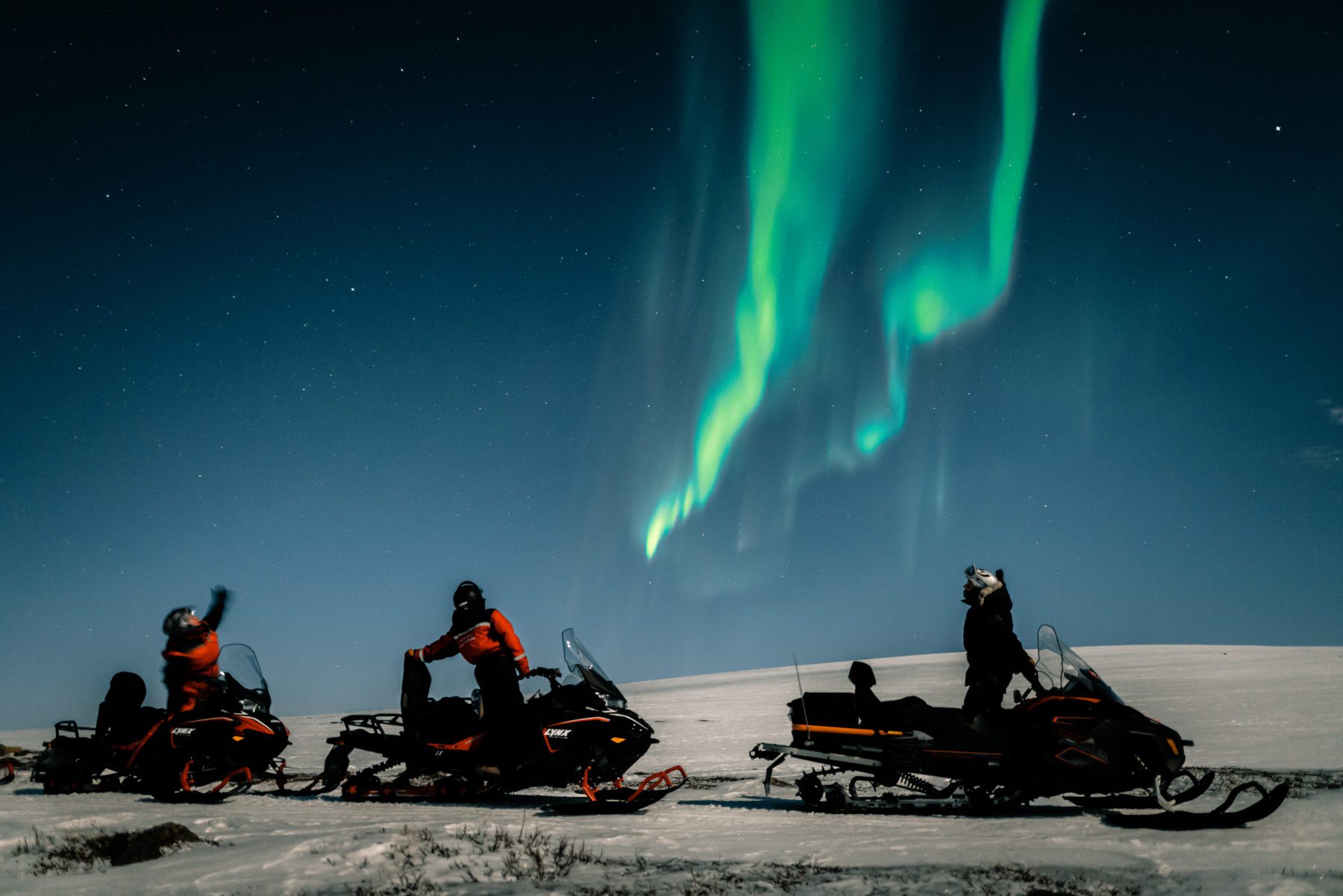
The Best Time to See the Northern Lights in Norway: A Month-by-Month Guide from Alta
The best time to see the northern lights in Norway is from September to March, with the season in the far north running from late August to mid-April. The aurora is active all year, but from mid-April to mid-August the nights are simply too bright to see it. On any given night, your best window is usually 6 pm to 2 am, with activity often peaking between 10 pm and midnight.
We live in Alta, a small Arctic town in Finnmark, Norway's northernmost region, and watch this sky every season. Which month suits you mostly comes down to what else you want from the trip: fall colors, the blue polar night, or snow and long, bright days. Here is the season month by month, plus our honest advice on when to book.
The best time to see the northern lights in Norway: the season in brief
The aurora is all about darkness. In Alta, at 70 degrees north, darkness returns toward the end of August, and by September the evenings are long enough for the season to be in full swing.
From around November 24–25 to January 17, Alta has polar night, called mørketid in Norwegian, when the sun stays below the horizon. It is not pitch black all day: around midday there is a soft blue twilight. It does mean many dark hours to look up. After the polar night the days lengthen quickly, while the nights stay dark until April.
Why can't you see the northern lights in summer?
From mid-April the nights become too light, and from around May 16 to July 27 the sun does not set in Alta at all. The midnight sun and bright nights hide the aurora, even though activity is still happening high above us. Only toward the end of August does it get dark enough again.
The best month for northern lights in Norway, month by month
The table below sums up each month in Alta. Temperatures are long-term monthly averages from yr.no, Norway's national weather service. A clear aurora night is often much colder, and inland on the Finnmarksvidda plateau it is usually colder than in town.
- September
- Darkness: Dark evenings, light days
- Average temp. in Alta: 8.2 °C / 47 °F
- What stands out: Equinox, fall colors, aurora over open water
- October
- Darkness: Long evenings
- Average temp. in Alta: 2.3 °C / 36 °F
- What stands out: Still near the equinox, first snow may arrive
- November
- Darkness: Polar night from about Nov 24–25
- Average temp. in Alta: −2.8 °C / 27 °F
- What stands out: Long nights, winter settles in
- December
- Darkness: Polar night all month
- Average temp. in Alta: −4.9 °C / 23 °F
- What stands out: Most dark hours, blue light at midday
- January
- Darkness: Polar night until about Jan 17
- Average temp. in Alta: −6.8 °C / 20 °F
- What stands out: The sun returns, deep winter
- February
- Darkness: Longer days, dark nights
- Average temp. in Alta: −7.0 °C / 19 °F
- What stands out: Coldest on average, great for winter activities
- March
- Darkness: Day and night equal around the equinox
- Average temp. in Alta: −4.0 °C / 25 °F
- What stands out: Equinox, Finnmarksløpet sled-dog race starts in Alta
- April
- Darkness: Dark nights until about mid-month
- Average temp. in Alta: 0.4 °C / 33 °F
- What stands out: End of season, light evenings
Fall: September and October
Nights get darker week by week, and the equinox in late September tends to bring more geomagnetic activity. Lakes and rivers have not frozen yet, so the aurora can be reflected in the water, and the landscape turns red and gold. This is the time for travelers who want northern lights without deep-winter cold.
Polar night: November, December and January
The nights are at their longest, and the aurora can appear as soon as it gets dark in the afternoon. The polar night has a mood all its own, with blue light over the snow in the middle of the day. Once the snow is down, aurora hunting pairs well with winter activities; see winter in Alta.
Winter with daylight: February and March
The sun is back, days get long and bright, and the nights are still dark. That leaves plenty of time for dog sledding, snowmobiling and Sámi culture by day and aurora by night. March also brings the equinox effect, and in early March the Finnmarksløpet sled-dog race starts in Alta; in 2027 the start is on March 5.
April: the end of the season
The first weeks of April can still deliver beautiful aurora over a snowy landscape, but the nights shrink quickly. By around mid-month the season is effectively over until fall.
Best time of night to see the northern lights
Once it is properly dark, the best hours are usually 6 pm to 2 am. Activity often peaks between 10 pm and midnight local time, close to what is called magnetic midnight, when Alta sits beneath the most active part of the auroral oval. Still, the aurora can appear at any time it is dark.
The northern lights tend to come in bursts. A quiet sky can suddenly explode into movement, then settle down again. That is why it pays to stay out for a few hours rather than step outside once. Warm layers make that far easier; see our guide on how to dress for the Arctic.
The equinox effect: why September and March are often strong
Around the March and September equinoxes, geomagnetic activity is on average higher than at other times of year. Scientists call this the Russell–McPherron effect. Put simply, Earth's magnetic field is angled toward the solar wind in a way that lets energy in more easily.
It is a statistical pattern over many years, not a guarantee for any single week. But it is a good reason why September, October and March are considered strong months for the northern lights.
Moon phases: full moon or new moon?
The aurora is clearly visible in moonlight, but a bright full moon makes faint aurora look paler. On the plus side, the moon lights up the landscape, which many photographers love. If you want the darkest possible sky, aim for the days around a new moon.
For winter 2026–2027, new moons fall around November 9, December 9, January 7, February 6, March 8 and April 7. Full moons fall around November 24, December 24, January 22, February 20–21, March 22 and April 21. You can check moon phases and moonrise for Alta on yr.no.
The solar cycle: what 2026–2027 means for the aurora
The sun goes through an activity cycle of roughly eleven years. The current one, Solar Cycle 25, peaked around late 2024 and 2025, and you can follow its progress at NOAA's Space Weather Prediction Center. Winter 2026–2027 falls in the declining phase.
That is no reason to wait. Historically, the declining phase still brings strong storms and often fast solar wind streams from so-called coronal holes, which can return roughly every 27 days as the sun rotates. And because Alta sits under the auroral oval, we do not depend on big storms; quiet nights can deliver aurora here too.
Which month should you book?
The short answer: pick the period that suits you, and plan several nights. Nobody can guarantee the aurora, but more evenings give you more chances if one night is cloudy.
- Milder weather and fall colors: September and October.
- The most darkness and the polar night mood: November to January.
- Aurora plus dog sledding, snowmobiling and bright days: February and March.
- The darkest possible sky: the days around a new moon.
Getting here is easier than many expect, with direct flights from Oslo; see how to travel to Alta. Before you go, our northern lights forecast guide shows you how to read the conditions, and the complete guide to the northern lights in Alta covers where to stay and what to expect.
Our guides read the weather and aurora data every evening and drive to wherever the sky is clearest. We bring extra warm clothing and help you with your camera settings. Explore our northern lights tours and find dates that work for you.
Your trusted guide to Arctic adventures. We specialize in creating unforgettable experiences in Alta, Norway.