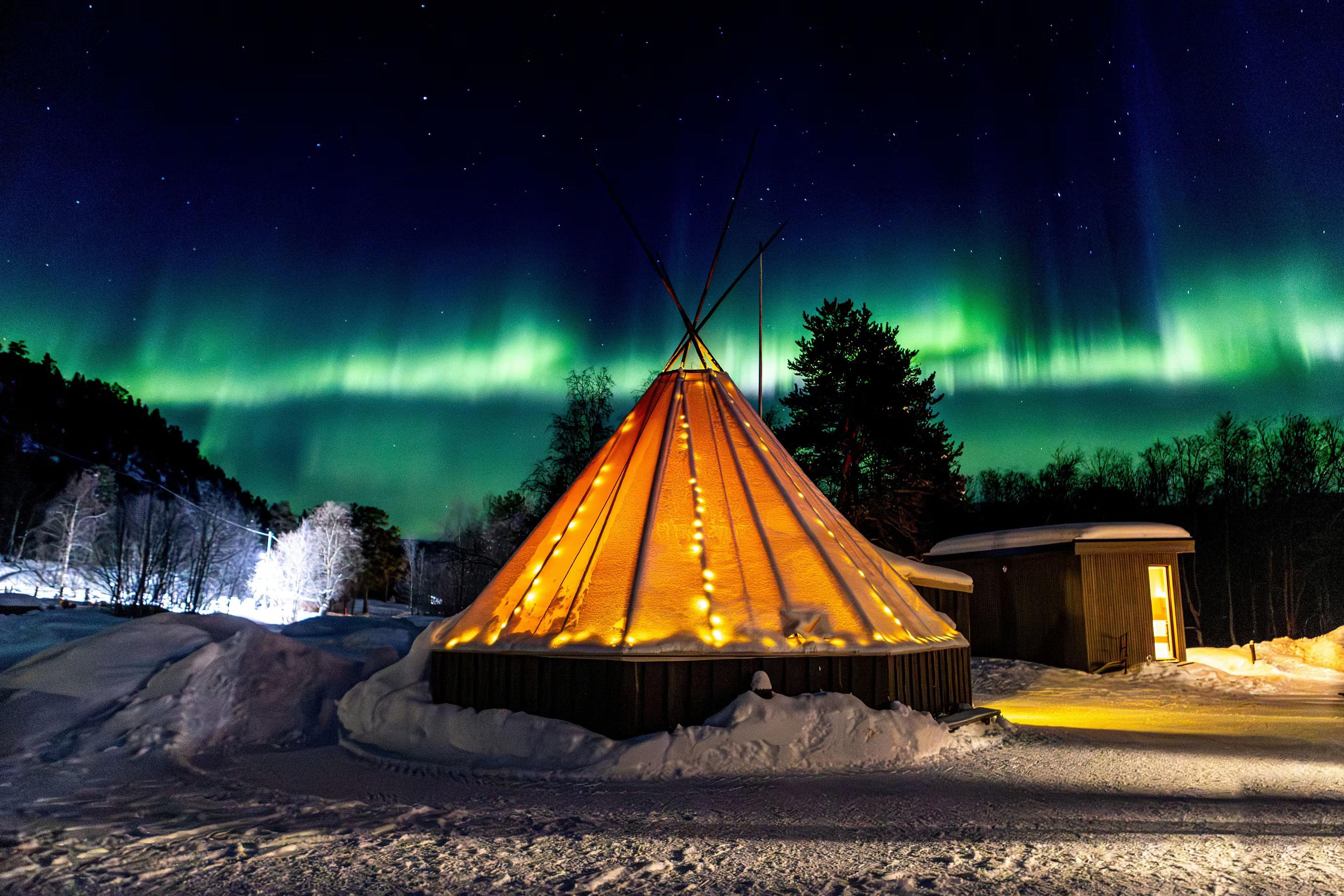
Northern Lights Live: Watch the Sky Over Alta Right Now
The fastest way to see the northern lights live is to open our webcams. They stream the sky over Gargia Lodge and Alta Fjord in Northern Norway, around the clock.
See a green arc or green bands on screen? That's the aurora. If you're in Alta, go outside and look north.
Northern lights live: two webcams in Alta
- Gargia Lodge, 25–30 minutes south of Alta at the edge of Finnmarksvidda, the Finnmark plateau. Dark skies, very little light.
- Alta Fjord (Altafjorden), closer to town, looking out over the fjord.
Stars mean clear skies. Only gray means clouds.
Clear on one cam and cloudy on the other? That tells you which way to head.
Watching the northern lights live from home? Alta is on Central European Time. If it's still light there, the cams show today's sunset time. Come back after dark.
Is it the aurora, or just clouds?
Faint aurora often looks grayish-white to the eye, a bit like a thin cloud. Here's how to tell them apart:
- Take a photo with your phone. Use night mode. If it turns green on screen, it's the aurora.
- Look for stars. Stars shine through the aurora. Clouds hide them.
- Check the shape. The aurora often forms an arc running east to west, or bands and curtains.
- Watch for movement. The aurora ripples, brightens and fades. Clouds drift steadily with the wind.
What to do in the next 15 minutes
- Dress warmly. You'll be standing still for a while.
- Get away from lights. Even a few hundred yards from streetlights and houses helps.
- Look north, then straight up. In Alta, the aurora can be right overhead.
- Give your eyes time. Full dark adaptation takes up to half an hour. Turn your phone brightness down, and use a red light on your headlamp.
- Stay out. The aurora often comes in waves. A quiet arc can burst into life within minutes.
In town? You can see strong aurora from there too, but a 15-minute drive into the dark makes a big difference.
Signs a burst is coming
- The arc gets brighter and wider.
- It starts to ripple and fold, like a curtain.
- It moves up toward the top of the sky.
- Solar wind data shows that Bz, the north–south direction of the solar wind's magnetic field, has been negative for a while. You can check it on NOAA's real-time solar wind page.
When it breaks loose, the sky can fill within minutes. Directly above you, the aurora may form a corona: rays that seem to meet at a single point.
Afterwards, fainter, pulsing patches often follow. Don't head inside right away. New bursts can come later in the night.
Quick photo tips
- Phone: Night mode, flash off. Rest the phone on something solid and keep it completely still.
- Camera: Wide-angle lens, widest aperture (e.g. f/2.8), ISO 1600–3200 and a 5–15 second exposure. Focus manually at infinity.
- Fast-moving aurora? A shorter exposure keeps the shapes sharp.
- Cold: Batteries drain fast. Keep a spare in an inside pocket.
Planning tomorrow night?
Use our northern lights tonight checklist in the afternoon, and learn how to read the northern lights forecast for Alta. Rather have a local guide chase clear skies for you? See our northern lights tours.
Your trusted guide to Arctic adventures. We specialize in creating unforgettable experiences in Alta, Norway.